Quick Answer
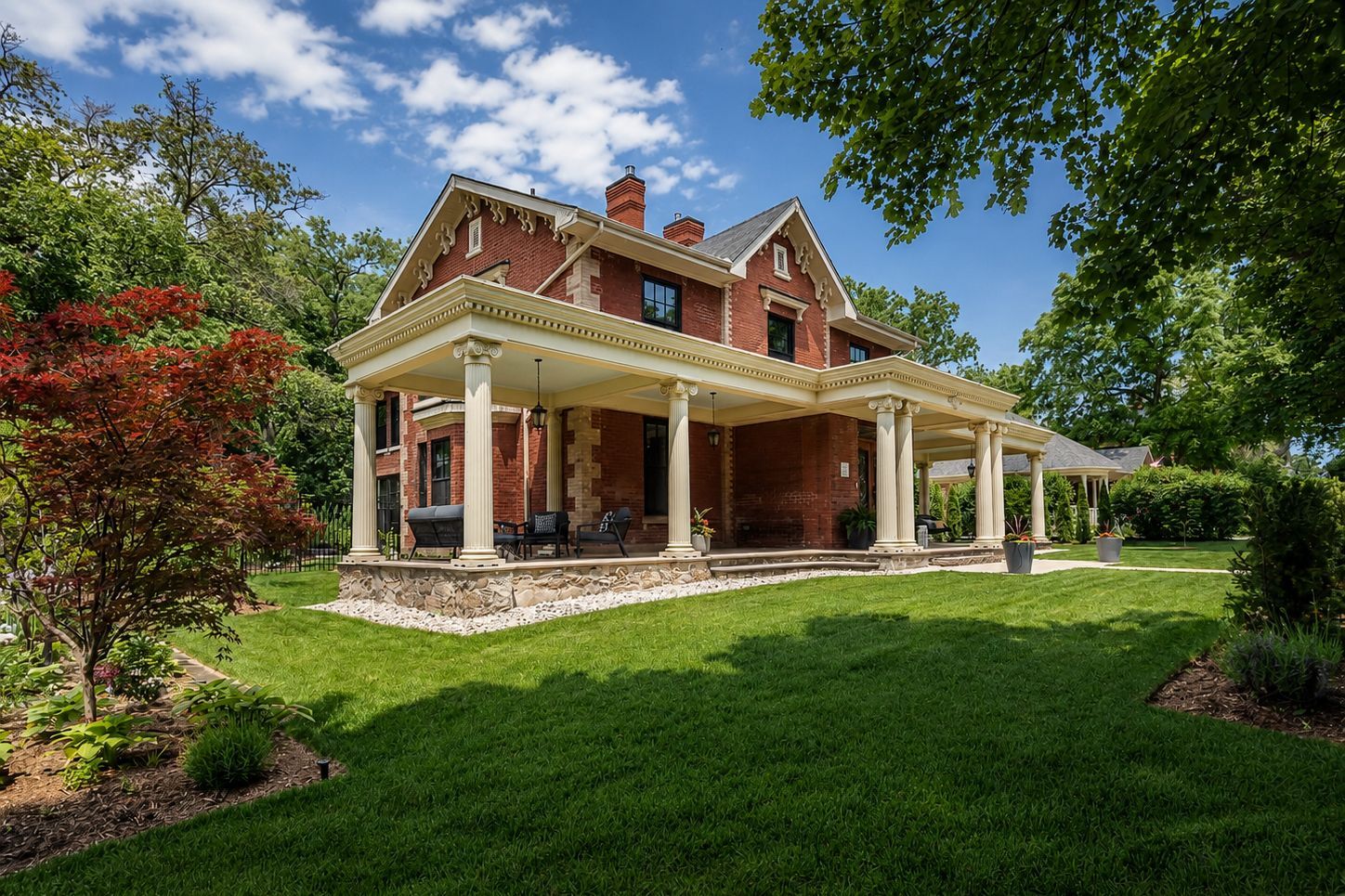
In June 1911, the owner of a Victorian house in Milton Ontario sealed a handwritten note inside the building and addressed it to whoever would eventually find it. It was found just prior to the recent restoration of 57 Victoria Street, known locally as The Judge's House, and the owner donated the entire contents to the
Milton Historical Society rather than keeping or selling them.
- The note is headed Felsgarth, the name the Gorham family gave the house, dated June 20th 1911, and opens with the words Compliments to the Finder.
- It records the building of the verandah that year, and names the stone mason.
- Sealed with it were letters and financial papers reaching back to 1853, including a promissory note, the notarial protest that followed it, and correspondence from 1904.
- The donation also included dozens of wallpaper samples taken off the walls during the restoration, spanning roughly a century of redecorating.
- The house was built in 1856 by Samuel Clarke, the man who founded Milton's first newspaper.
- It takes its name from the judges of the Halton County Court who owned it through the late 1800s and early 1900s.
- The whole collection is now held at
Milton Historical Society at 16 James Street and can be viewed by appointment.
Most old houses in Milton Ontario give up something during a renovation. A newspaper stuffed in a wall cavity. A boot under a floorboard. Almost all of it ends up in a skip, and the few things that survive end up in a box in somebody's basement, unlabelled, meaningless within a generation.
This one went the other way. What came out of
57 Victoria Street went to the town's archive, catalogued and public, where anyone can ask to see it.
We have sold homes in this town for more than two decades and have handled a great many century properties. We have never seen a find like this one, and we have certainly never seen an owner hand the whole of it back.
Compliments to the Finder
Who built The Judge's House
The land was part of the original Jasper Martin holding. His son John Martin registered the lots in this area as Plan 17. In June 1855 the lot was bought by George Brown, Milton's first mayor, and sold the following month to Samuel Clarke.
Clarke is the reason the house is documented at all. An Irish immigrant and a graduate of Trinity College Dublin, he had bought 200 acres in Trafalgar Township in 1833, sat on the township council, represented it at the Gore District Council, and served as Warden of the District of Gore from 1847 to 1849. He was a founding member of the Halton Agricultural Society and its first Secretary Treasurer.
In 1855 he founded the Halton Journal, the first newspaper this town ever had. He ran it for nine months before selling it on.
He had the house built in 1856. In June 1857 that same newspaper, now under new ownership, reported that a number of new buildings had gone up the previous year, with twenty more under construction. Clarke built the house, founded the paper that recorded the building of the town, then left Milton in the spring of 1857 for the Niagara area.
There is a footnote worth keeping. Before it was sold, the house was considered by the Methodist Church for use as a manse. Approval could not be obtained.
The doctor, and a house described down to the lamp
Why it is called The Judge's House
Judges of the Halton County Court owned and lived in this house continuously from 1868 to 1928, and the name attached itself to the building and stayed there long after they were gone.
Miller was born in Nelson Township, educated at Queen's College in Kingston, and appointed county judge of Halton in 1867. He held a captain's rank in the 29th Waterloo Battalion and volunteered in readiness for the Fenian Raids. The record describes him as one of the most conscientious of men who administered the law without favour.
Judge Hamilton bought the house in 1895 with his wife Mary Eliza, a daughter of Chief Justice Draper. He had studied law in the office of Sir John A. Macdonald in Kingston. That autumn he built an addition, and the Canadian Champion reported it.
Judge Gorham arrived in 1901 from Port Arthur, where he had been Crown Attorney and served two years as Mayor. He and his wife Annabella gave the house the name Felsgarth. The family held it until 1928.
What was sealed inside
Reading a house through its wallpaper
The wallpaper did not come out of the capsule. It came off the walls.
It is one of the largest parts of the donation and the part that surprised us most.
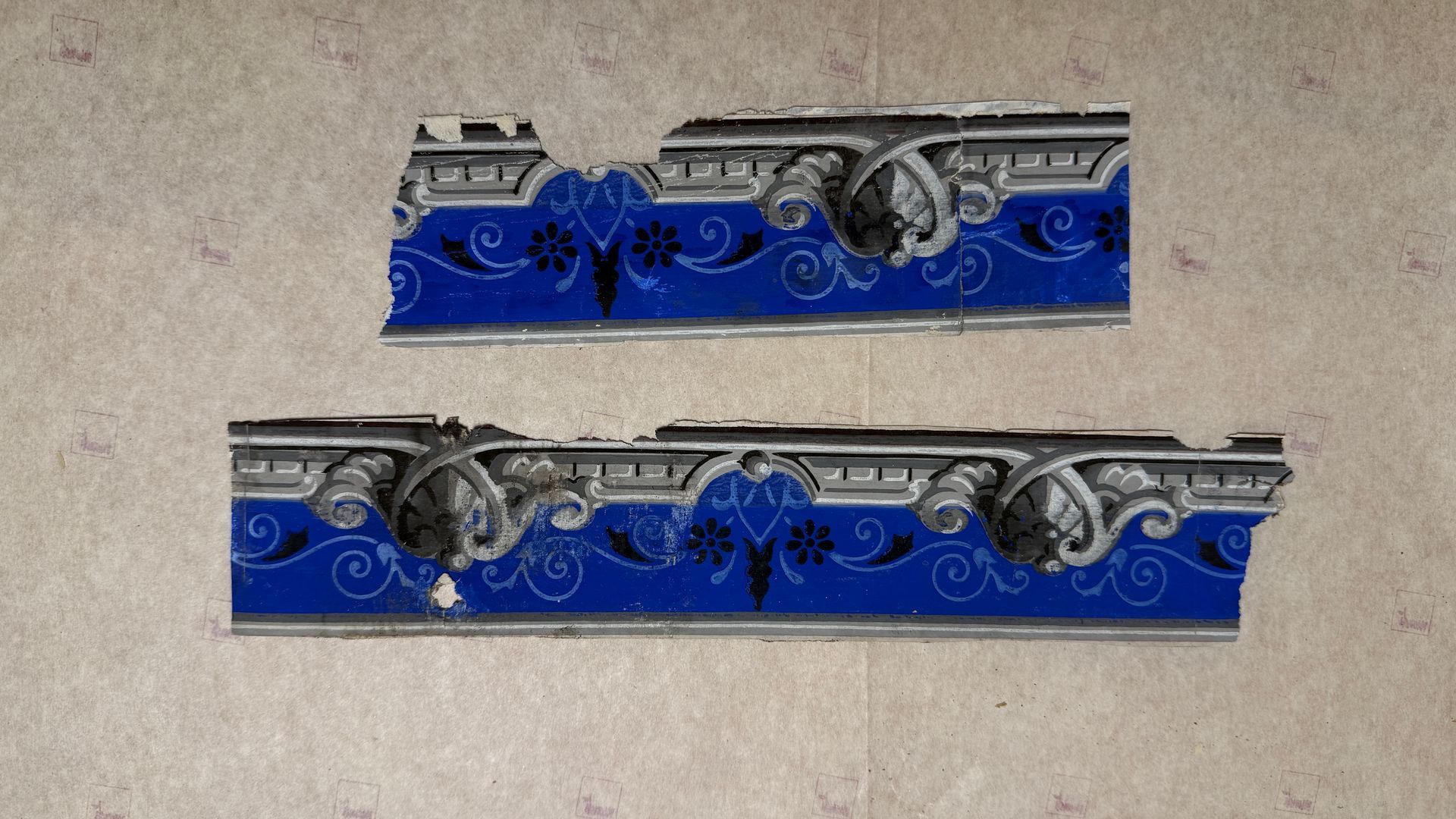
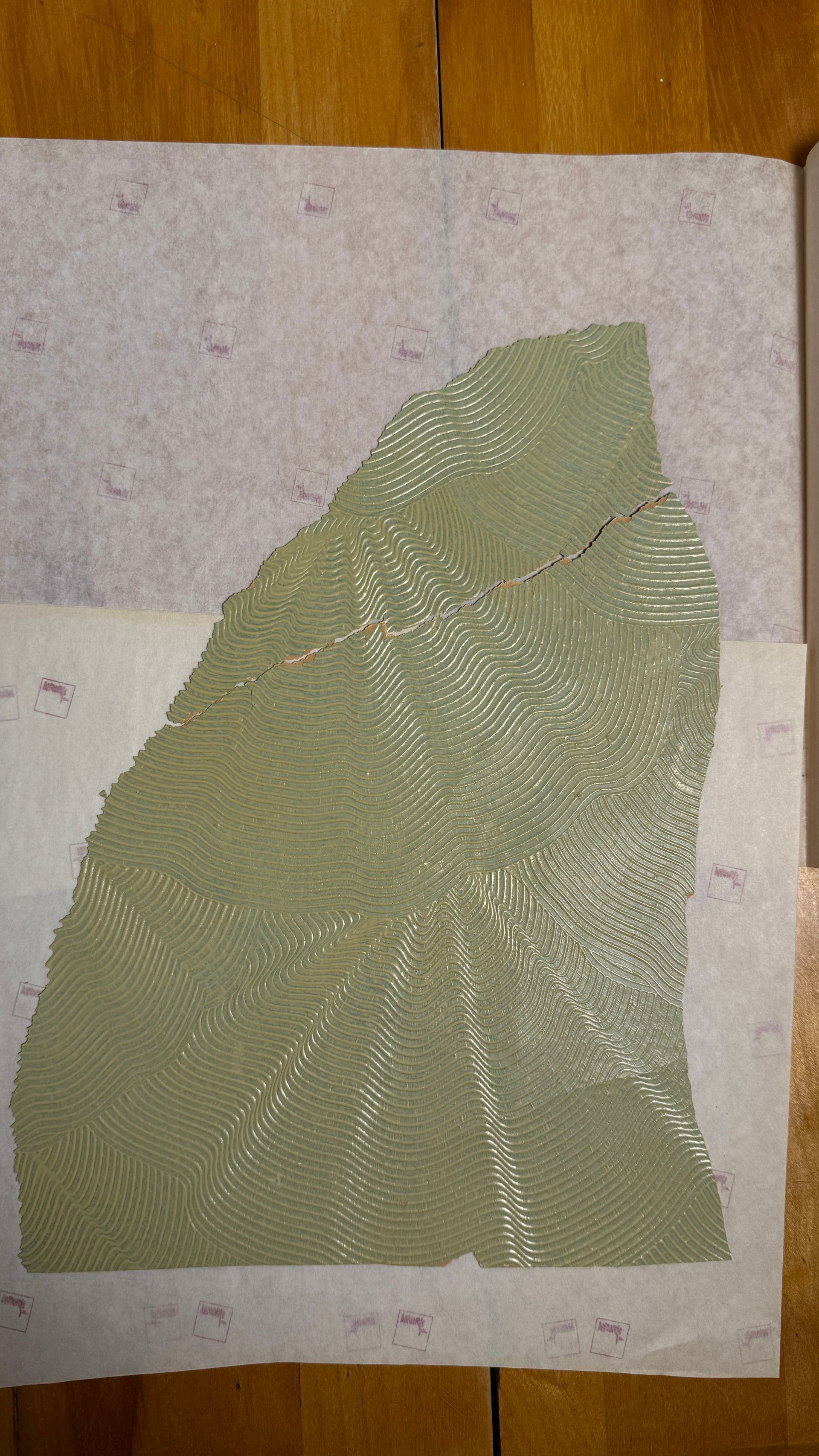
Layer on layer, taken off the walls during the restoration and now laid out flat on archival tissue. A pale ground carrying full blown roses and chrysanthemums in crimson and rose, with grey blue scrollwork behind. A cobalt blue frieze with silver scrollwork and black florets, the sort of thing that contradicts everything people assume about Victorian interiors being dim. Sage green in a heavy embossed wave, still catching the light. Olive damask. Mint green paint. A delicate pink sprig on cream. A blue grey field scattered with white dots, finished with a border stripe of metallic edged medallions.
Each layer is somebody's decision. A family arrives, the house gets redecorated, and thirty years later the next family papers over it. Strip it all back at once and you are looking at a hundred years of taste stacked in order, like rings in a tree.
Nothing in the capsule tells you as much about how it actually felt to live here.
Nature's Symphony
Breathtaking colors of our planet
Button
Faces of Humanity
Portraits of people from around the globe
Button
Sands of Time
Stark beauty of desolate dunes
Button
Two letters, seven days apart
Among the correspondence are two pages that should be read together.
The first is dated March 19th, 1904, and comes from Rainy River, in the far northwest of Ontario. A child is writing to Uncle Tom. They are sorry to hear that Gorden is so ill and hope he will soon be better. They suggest, with complete seriousness, that if he would come out here and shoot rabbits he would get better. The writer reports that they have not spent the money sent at Christmas. They are saving for college. Ten dollars saved last year, fifty four dollars in the bank now. There was no school here all winter.
The second is dated March 26th, 1904, from Milton, written on paper with a heavy black mourning border.
Dear Mrs Gorham. Words seem so cold at a time like this when one's heart and thoughts are so full. My heart goes out to you in the
loss of your dear one in whom so much of your love and interest were centred.
Seven days between them. One letter hoping, one letter mourning.
Both were sealed into the house in 1911, seven years after they were written. Somebody went looking for those two pages, put them in with the rest, and closed it up. That was a choice.
We are not going to embroider it further. It does not need it.
Nature's Symphony
Breathtaking colors of our planet
Button
Faces of Humanity
Portraits of people from around the globe
Button
Why the collection went to the Milton Historical Society
The owner could have kept it. Framed the best pieces, put the rest in storage, sold the interesting bits. Nobody would have thought twice.
Instead the whole donation went to the Milton Historical Society during the restoration. The capsule and its contents, the wallpaper recovered from the walls, and the research gathered along the way. It now sits in the Cooke and Dills Archives at 16 James Street, above the Waldie Blacksmith Shop, catalogued alongside the Society's other holdings and available to anyone who asks.
This matters more than it sounds. The Society has researched and plaqued 57 Victoria Street already, as it has for more than two hundred properties across the town. Victoria Street alone carries fourteen plaqued homes running from 1856 through to 1907. That research only exists because people hand things over.
Everything we have written above came out of that archive. None of it would be knowable otherwise.
What the restoration kept
The house was taken back to the exterior brick and the roof joists between 2022 and 2024 and rebuilt with steel support beams. The Victorian envelope stayed. Almost everything behind it is new.
The verandah is the part that closes the circle. The 1911 note records it being built. A photograph published in the Society's own record of Milton's historic homes shows it in place, wrapping the front of the house. What stands today is not the full original extent, but the columned porch was preserved through the restoration, and the Doric columns and the facade corbels came through with it. The structure the note was written about is still there to be walked onto.
The rest of what survived on purpose is the part that matters here. The original wood in the front foyer. The ten foot ceilings on both floors. The arched openings, echoed deliberately in the new cabinetry and doorways so the language of the house carries through.
Traces of the removed rear extensions are still legible in the brickwork along the back. One of those was almost certainly Judge Hamilton's 1895 addition. A decision made a hundred and thirty years ago, undone, and still readable in the wall.
A restoration at this level is not decoration. It is a series of decisions about what to keep, and every one of them is a judgment call about which century the house belongs to. Getting them right is the whole job.
Thinking About a Heritage Home in Milton?
We have been ranked number one in Milton since 2009, and a real part of that is knowing what a property actually is before we ever talk about what it is worth. On a century home that means the register status, the permit history, and what a restoration did or did not cover behind the walls.
If you are buying or selling a heritage property in Milton or anywhere in Halton, book a consultation at flowersteam.ca or call the team at 905-878-6232.
Frequently Asked Questions
Where is The Judge's House in Milton Ontario?
57 Victoria Street, in Old Milton, on more than half an acre backing onto protected conservation land. It was built in 1856 and is one of the town's most recognizable houses.
Why is it called The Judge's House?
Judges of the Halton County Court owned it through the late nineteenth and early twentieth centuries. Thomas Miller bought it in 1868, John Hamilton in 1895, and Thomas Ambrose Milne Gorham in 1901. It has also been known as The Doctor's House, after Dr. William Hume, and as Felsgarth, the name the Gorham family gave it.
What was in the 57 Victoria Street time capsule?
The capsule was sealed in June 1911 with a handwritten note addressed to whoever would find it. Sealed alongside it were promissory notes from the 1850s, family correspondence including two letters from 1904, and a newspaper from the month before. These were just a few of the many items of history that were found. Wallpaper recovered from the walls during the recent restoration was donated at the same time but did not come out of the capsule.
Where can I see the collection?
The Cooke and Dills Archives at 16 James Street in Milton, open Monday and Wednesday from 10am to 1pm and at other times by appointment. The Milton Historical Society can be reached at 905-875-4156.
How do I research the history of my own Milton house?
Start with the Milton Historical Society archives. They hold property research for hundreds of homes in the town and run a house plaquing programme that researches a property at their own expense. The Town of Milton heritage register is the second stop.
Does a heritage home hold its value in Milton?
Supply is genuinely fixed, which supports value over time. What actually drives the number is the quality of the restoration and the condition of the structure behind the finishes, not the age of the building. After more than 3,000 transactions in this town, that is consistently what separates a good outcome from an expensive one.
Sources
Milton Historical Society, property research for 57 Victoria Street, and the Cooke and Dills Archives. Ownership chain, biographical detail, the Felsgarth name, the 1895 addition, and the photograph showing the 1911 verandah.
https://miltonhistoricalsociety.ca/
Canadian Champion, February 11, 18 and 25, 1864. Auction inventory of Dr. William Hume's estate, sold at the home on February 27, 1864.
Halton Journal, June 1857. Report of new buildings erected in Milton the previous year.
Primary material from the 57 Victoria Street donation, Milton Historical Society. Sealed in the 1911 capsule: the note, the 1853 promissory note, the 1854 notarial protest, the 1904 correspondence, and the Financial Post of May 20, 1911. Donated alongside it: wallpaper recovered from the walls during the 2022 to 2024 restoration.
Town of Milton, Heritage Designation and Heritage Register.
https://www.milton.ca/en/business-and-development/heritage-designation.aspx
Disclaimer
This article is provided for information purposes and is not intended to solicit properties currently listed for sale or under contract with another brokerage. Heritage register status changes over time. Confirm the current status of any specific property with the Town of Milton before relying on it. Archival material referenced here is held by the Milton Historical Society.