Why do families buy in Beaty twice?
Because the thing they came for does not move.
When New Milton was first taking shape in the early 2000s, Beaty was the sought-after address, and the reason was the schools. Two of them, one public and one Catholic, both highly regarded, both walkable from most of the neighbourhood. Families planned their entire move around that.
What happened next is the interesting part. Those families outgrew their first house. In most towns that means a new neighbourhood, a new school, and a child starting over socially in Grade 5. In Beaty it means crossing a street.
The buyers we work with here routinely give us two requirements and only two: a double car garage, and it has to be Beaty. Everything else is negotiable.
That loyalty is the most useful thing a buyer can understand about this neighbourhood, because it explains the demand, the resale strength, and why so little comes up on the best streets.
What is the invisible line in Beaty?
Clark Boulevard, the main east-west street running through the community.
North of Clark is where a lot of the
townhouses and semi-detached homes sit. It is the entry point, and it is where a large share of Beaty families started.
South of Clark is the larger-lot half:
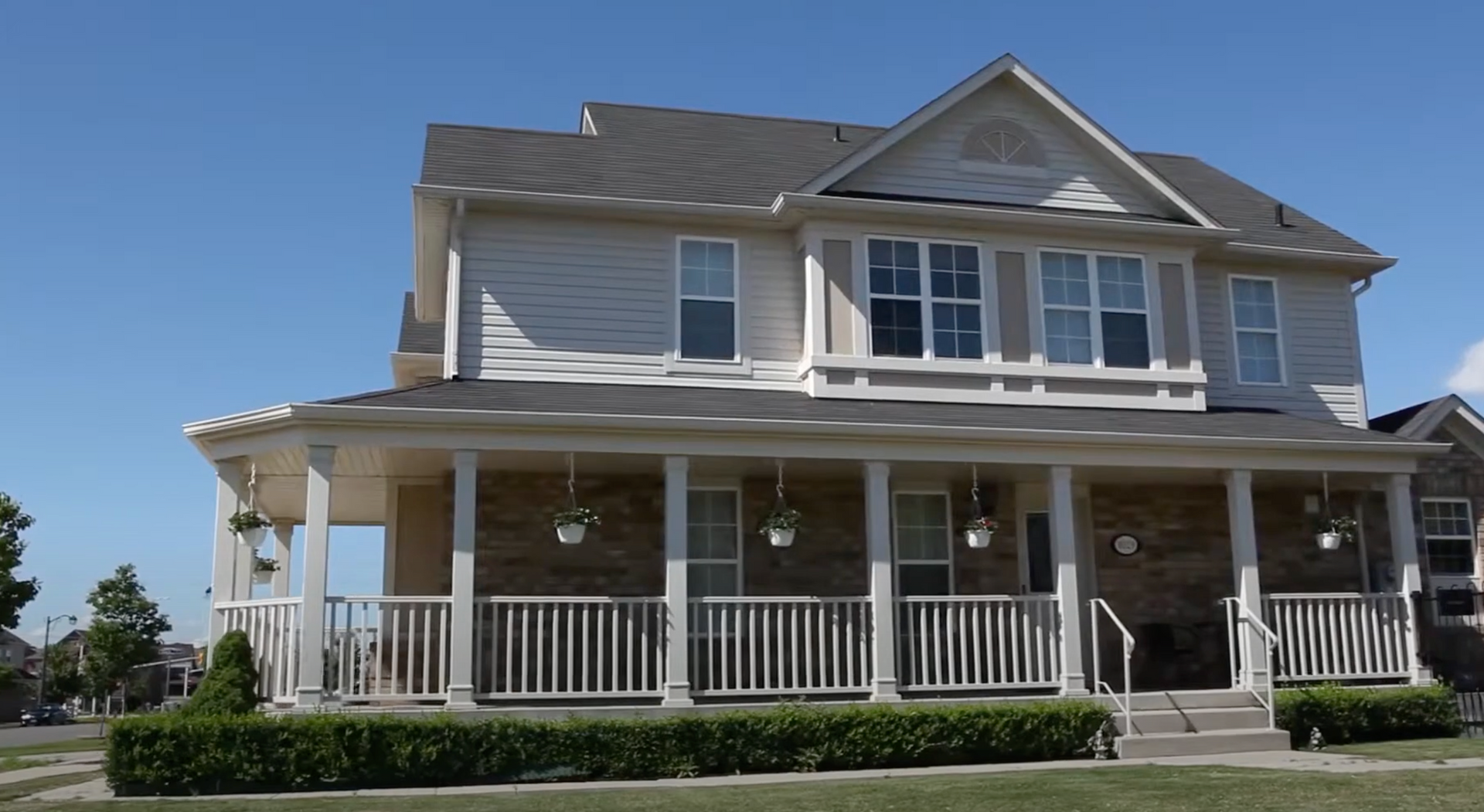
double car garage detached homes, some single car garage detached, and quiet residential streets. This is where the move-up happens, and it is why the second purchase does not require leaving.
That single line explains more about Beaty pricing than any other feature of the neighbourhood. Two homes with similar square footage on opposite sides of Clark are not competing for the same buyer.
Can kids really walk to school in Beaty?
From essentially anywhere in the neighbourhood, at the elementary level. That is not a claim about theoretical walkability. Beaty was laid out so that it would be true.
- Hawthorne Village Public School (HDSB): in the neighbourhood, award-winning, and a named draw for families choosing Beaty.
- Guardian Angels Catholic Elementary (HCDSB): in the neighbourhood, among the highest-rated schools in Milton, and the other half of the reason people move here.
- Irma Coulson Public School (HDSB): in the neighbourhood on the south side of Derry Road, and among Milton's top-rated public elementary schools.
- Craig Kielburger Secondary School (HDSB): at the very south end of Beaty, which means the walk to school does not end when high school starts.
- St. Kateri Tekakwitha Catholic Secondary School (HCDSB): a short drive south.
The high school detail is the one buyers underestimate. In most Milton neighbourhoods, walkability quietly expires around Grade 8. In Beaty it carries through, and parents who have driven a teenager to school in another town know exactly what that is worth.
Schools are as per zoning to your home address. Confirm the assignment for any specific address with the Halton District School Board school finder or the Halton Catholic District School Board school finder.
What is the gas line path?
A walking corridor that runs the length of Beaty along the gas line, and the single most used piece of infrastructure in the neighbourhood.
It is a dog-walking route first and a shortcut second, and it connects into the wider trail corridor that carries through to Coates and Willmott as one continuous green route. If you stand anywhere in Beaty on a mild evening, the people you see are on that path.
For buyers, it functions as a second frontage. A home a short walk from the corridor lives differently from one that is not, and that difference does not show up in a listing photograph.
Where do Beaty neighbours actually meet each other?
Not at street parties, and not at neighbourhood garage sales. Those are not really a Beaty thing, and buyers coming from an older Milton neighbourhood should calibrate for it.
What Beaty has instead is school pickup and the path. Everybody walks. The social life of the neighbourhood happens on the sidewalk at 3:15 and on the gas line trail with a dog at 7. There is also a strong community Facebook group doing a lot of the work that a street party used to do, which is worth joining before you move in rather than after.
The Bennett Boulevard rush hour nobody warns you about
Bennett Boulevard is the street the schools sit on, and Bennett and Clark both get busy at drop-off and pickup.
The congestion is worth understanding because it is not mostly cars. It is kids: on foot, on bikes, and increasingly on electric scooters and e-bikes, which have become popular enough that they are now a live conversation in the neighbourhood rather than a novelty. Not everyone loves it. Rules for e-scooters and e-bikes are set municipally and have been changing Currently Milton has a ban on all electronic scooters and bikes on municipal roads, however there is minimal to no the enforcement and that is what has people talking.
Our practical advice for anyone shopping near the school streets is the same one we give in every neighbourhood where this comes up: walk the block on a weekday at 3:15, not on a quiet Sunday morning. It is the same kind of on-the-ground check we build into
our buyer's guide.
What is a Mattamy wide lot, and does it actually get you anything?
If you shop Beaty you will hear about wide lots, because Mattamy built this section and the WideLot concept was central to how they marketed it.
The pitch was frontage. Wider lots make for a broader, more open street profile, and Beaty genuinely has that. The part that did not make the brochure is depth. Many of those wide lots run only about 80 feet deep, so the total yard is not larger than a conventionally proportioned lot, it is shaped differently. You get more street presence and less back yard.
That is not a criticism of the homes, which have held their value very well. It is a caution about reading a lot dimension on a listing and assuming it means outdoor space. Look at the yard, not the frontage number.
What can you walk to in Beaty?
Less than you would expect from the size of the neighbourhood, which is deliberate. Beaty was built as a residential district, not a retail one, and the commercial that is here is scaled to everyday needs rather than destination shopping.
- Hawthorne Village Square: the in-neighbourhood plaza, with a 24-hour food store, medical and dental offices, and local favourites including Portobello's. The pizzeria has been in town for years and doubles as a casual dining restaurant, and it draws a steady Friday night walk-up crowd from both Beaty and neighbouring Clarke.
- The Thompson and Louis St. Laurent plaza: the closest full-service stop, anchored by FreshCo grocery, with Dollarama, Scotiabank, a Hakka restaurant, and a Starbucks, plus Shoppers Drug Mart at the same intersection.
- Beaty Branch, Milton Public Library: a library branch inside the neighbourhood, which very few Milton communities can claim.
That is genuinely the list, and residents will tell you it covers the everyday. Because of where Beaty sits, everything else is a short drive rather than an expedition.
What sells fastest in Beaty, and why is there so little of it?
Homes that have been renovated, or refreshed for design, sell for meaningfully more here. That means kitchen cabinets either replaced or professionally painted, fresh paint throughout, and often some flooring replacement. Buyers moving into Beaty want the newer look, and they will pay for it.
The problem is supply. Beaty is not old enough to force renovation. Homes built in the early 2000s are comfortable, functional, and in no state of emergency, so most owners have not done the work. Roof replacement is the wave currently moving through the neighbourhood. Windows have not started in earnest yet, but they are coming.
Our seller's guide goes through which of those projects actually returns at resale.
That gap between what buyers want and what is available is the entire Beaty pricing story, and it is the clearest opportunity we see for sellers here.
The Flowers Team stages in-house, and in a neighbourhood where the finished homes are the scarce ones, presentation is not a nice extra. In 2025 we sold homes 7 days faster and for $13,832 more than the average Milton agent.
Is anything changing in Beaty?
No, and residents count that as a feature.
The community is complete. There is no vacant land inside it, no phase still to be released, and no plan that will change the shape of the streets. Development in this part of town has moved on to the other side of Louis St. Laurent Avenue. What has changed in Beaty over the last decade is that the trees have filled in, and that is about it.
For a buyer, that certainty is worth something. You are not guessing what the view will be in three years, and you are not buying beside a construction schedule. What does move is price, which we track in
our monthly Milton market reports.
The family who moved up without moving out
One family we worked with bought their first home in Beaty when New Milton was just getting started, and they loved it enough that when they outgrew it, the search barely qualified as a search.
They came to us with two requirements. Double car garage. Beaty. That was the entire brief. Not a street, not a school, not a price bracket first. They had already decided the district was not up for discussion, and everything else got sorted around it.
We found them a home on the other side of Clark Boulevard. The children did not change schools, did not change friends, and did not really notice the move as anything more than a bigger house a few streets over. That is the Beaty transaction in one sentence, and we do a version of it every year. You can read more of those moves in
what our clients say.